
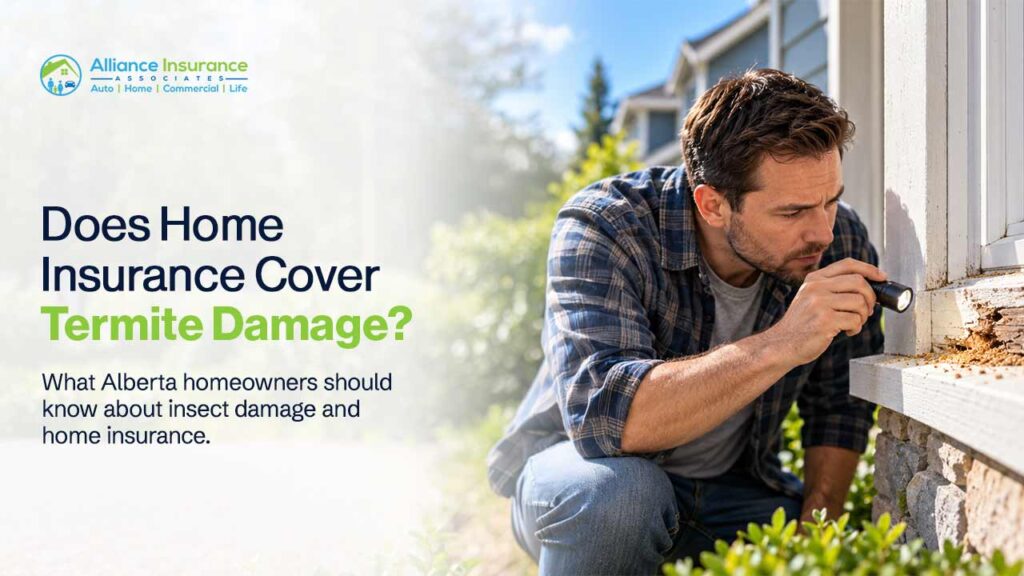
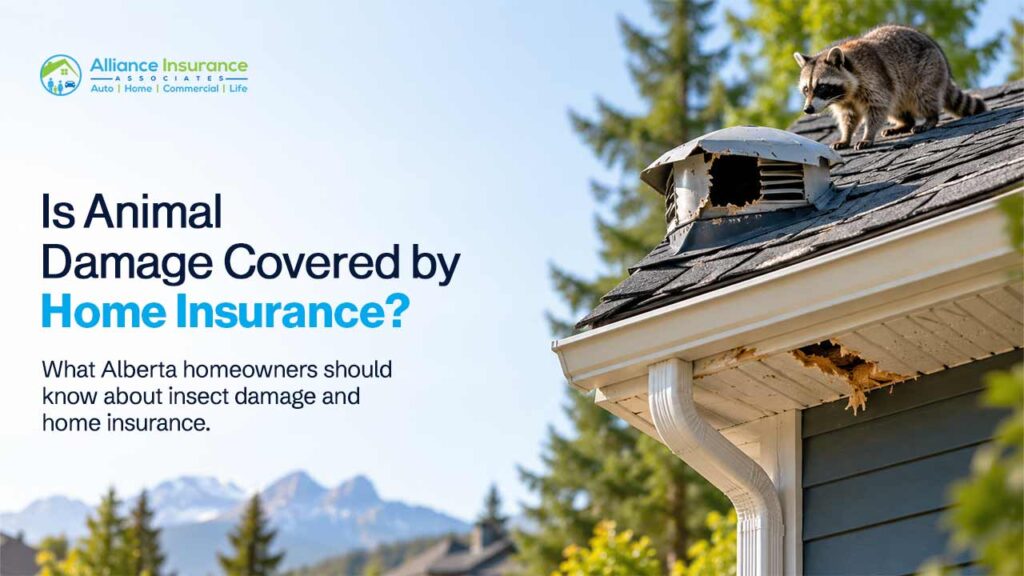

Short answer: standard home insurance in Alberta and British Columbia does not cover pest damage, extermination, or wildlife removal. Insurers treat infestations as a maintenance responsibility, not a sudden accident. But there is one exception worth knowing, and it can be worth thousands: when a pest causes a separate insured loss, such as a fire from chewed wiring, the resulting damage is usually covered.
There is also a local wrinkle almost nobody writes about. The right answer to “are termites covered?” looks very different in Kelowna than it does in Edmonton, because one of those cities has termites and the other effectively does not.
Key Takeaways
- Pest damage, extermination, and wildlife removal are excluded from virtually every standard Canadian home, condo, and tenant policy.
- The resulting damage is different. If a mouse chews a wire and a fire follows, the fire damage is typically a valid claim.
- Termites are a BC concern. Alberta has no established termite populations. Albertans who think they have termites usually have carpenter ants.
- Alberta has been essentially rat-free since 1950, and reporting a rat is a legal obligation, not a courtesy.
- In rentals, tenancy law does the heavy lifting, not insurance. Landlords in both provinces are generally responsible for treating infestations.
- Bats cannot legally be removed year-round in BC. Timing matters before insurance does.
Quick answer by pest
| Pest | Damage covered? | Removal covered? | The usual exception |
| Bed bugs | No | No | None. In a rental, the landlord generally pays for treatment |
| Mice | No | No | Fire or sudden water escape caused by chewing |
| Rats | No | No | Same. In Alberta, rats must also be reported |
| Squirrels | No | No | Resulting fire or water damage |
| Raccoons and skunks | Usually no | No | Depends how your wording defines “vermin” |
| Bats | No | No | Removal is also season-restricted in BC |
| Carpenter ants | No | No | Often paired with an excluded moisture problem |
| Termites | No | No | A BC issue, effectively absent in Alberta |
| Deer, bear, moose | Often yes | N/A | Sudden entry by large wildlife is treated differently |
| Your own pet | No | N/A | Liability may respond if your pet damages someone else’s property |
Why do insurers exclude pests
Insurance covers losses that are sudden, accidental, and unforeseen. An infestation is none of those things. It develops over weeks or months, produces warning signs, and can usually be stopped by acting early.
That principle sits behind a clause commonly called the vermin exclusion. Typical Canadian wordings exclude loss or damage caused by birds, vermin, rodents, insects, or domestic animals. The same logic excludes rust, rot, mould, and general wear and tear.
The exception that actually matters
Most policies contain a carve-back for ensuing loss, sometimes called resulting damage. The pest damage stays excluded, but a separate insured peril triggered by it may still be covered.
In practice:
- A squirrel chews through wiring in your attic. The chewed wiring and insulation: excluded. A fire that later starts from that wiring is usually covered.
- A mouse gnaws a supply line, and your basement floods. The pipe repair and the mouse problem: excluded. The sudden water escape damage is often covered, depending on your water damage endorsements.
One caveat. If an adjuster concludes you knew about the problem and ignored it, the fortuity argument weakens, and the claim can still fail. Documentation of when you found the issue and what you did about it is your best protection.
Three things Alberta and BC homeowners get wrong
Termites are a BC problem, not an Alberta one
Canada has three pest termite species, and two are native to British Columbia: the western subterranean termite and the Pacific dampwood termite. The BC Ministry of Agriculture’s plant health guidance documents activity on Vancouver Island, along the south coast and through the dry Interior from Kamloops south, with Kelowna a recognized hotspot.
Alberta has no established termite population. If you are in Edmonton or Calgary and you found small winged insects in your foundation, you are almost certainly looking at carpenter ants.
That distinction is practical, not academic. Carpenter ants do not eat wood; they excavate it, and they strongly prefer wood that is already moisture-damaged. So a carpenter ant discovery often reveals a second excluded problem underneath: a long-running leak.
Alberta is rat-free, and reporting is the law
Alberta has maintained a Rat Control Program since 1950, operating a control zone roughly 600 km long and 29 km wide along the Saskatchewan border. It has kept the province essentially rat-free for more than 70 years.
Under the Agricultural Pests Act, Norway rats are declared pests. Every person and municipality has an affirmative duty to prevent rats from establishing on their property. Keeping pet rats is illegal.
If you see one, report it to 310-RATS (7287) or through the provincial rat control program. Insurance will not pay for the damage either way, but in Alberta, this is a regulatory matter as well as a maintenance one.
Metro Vancouver, by contrast, has well-established Norway and roof rat populations. Identical policy exclusion, completely different risk profile.
Bats are a legal question before an insurance one
Bats are protected under the BC Wildlife Act and may not be harmed, harassed, or killed. The only acceptable method is humane one-way exclusion, and it cannot be done during maternity season. BC Community Bat Programs advises excluding only before mid-June or after mid-August in most of BC, because sealing a roost while flightless pups are inside traps and kills them.
Removal, guano cleanup, and insulation replacement are all excluded from your policy. Bats also do not chew wiring, so the real cost driver is contamination rather than structural damage.
Renting? Tenancy law decides, not your policy
This is where most searches for “does tenant insurance cover bed bugs” are really headed.
In Alberta, the Residential Tenancies Act requires landlords to keep premises habitable throughout the tenancy. The province’s own landlord and tenant guidance uses “there are no bed bugs” as its example. The Minimum Housing and Health Standards require owners to keep premises free of insect and rodent infestations. In Hometime Property Services Ltd v Girumnesh (2022 ABPC 172), an Alberta court dismissed a landlord’s roughly $8,000 claim against a former tenant over a mouse infestation, holding the landlord bore the cost.
In British Columbia, section 32 of the Residential Tenancy Act and RTB Policy Guideline 1 place the responsibility for infestation treatment with the landlord. The Ministry of Housing has stated that landlords cannot charge tenants for bed bug remediation, regardless of who does the work. TRAC’s tenant guidance sets out the dispute resolution route.
Tenants still carry duties: report promptly in writing, keep the unit reasonably sanitary, and cooperate with treatment prep. Delay or obstruction can shift some costs. Never withhold rent, which is grounds for eviction in both provinces.
What to do in the first 48 hours
- Photograph everything before you remediate, with visible dates.
- Call a licensed pest professional and keep the invoice and inspection report.
- Write down when you first noticed the problem. This single note protects you later.
- Tenants: notify your landlord in writing the same day.
- In Alberta, report suspected rats immediately.
- If a fire, flood, or collapse occurs, report it to your insurer right away. Fire is an insured peril on every standard form.
- Call your broker before assuming anything. Asking a coverage question is not filing a claim and does not go on your record.
Coverage worth asking your broker about
No endorsement buys pest coverage in Canada. Several adjacent coverages can respond to the fallout, and wording varies meaningfully between insurers.
| Endorsement | Why it may matter |
| Service line coverage | Underground water, sewer, power, and data lines are excluded from base policies. Some wording lists animal damage among the covered causes |
| Equipment breakdown | May respond to sudden electrical failure of a furnace or HVAC unit, the exact failure mode when rodents chew a harness |
| Water damage and sewer backup | Determines whether the ensuing water escape is covered at all |
| Comprehensive auto | Rodents nesting in engine bays are a rising claims category. Aviva reported a 28% year-over-year increase in rodent-related motor claims in 2024 (UK data, same winter mechanism) |
The challenge: these wordings are not standardized, and two insurers can reach different conclusions on identical facts. The solution: have someone read your actual policy before a loss, not after. That is the core argument for using a broker rather than buying a single carrier’s wording directly. You can learn more about how our brokerage works or talk through your policy with us.
If your claim is denied
- Request the denial in writing, citing the specific clause relied on.
- Escalate internally: adjuster, then claims manager, then the insurer’s complaints officer.
- Complaints about a broker or adjuster: Alberta Insurance Council or the Insurance Council of British Columbia.
- Complaints about the insurer’s conduct: BC Financial Services Authority in BC, the Superintendent of Insurance in Alberta.
- Free independent dispute resolution: the General Insurance OmbudService.
If you are mid-claim already, our claims support page walks through the reporting process.
Where is this heading
Pressure on the exclusion is only increasing. The Insurance Bureau of Canada reports insured losses from catastrophic weather rose from $14 billion between 2006 and 2015 to $37 billion between 2016 and 2025, with claim counts nearly doubling. Severe weather losses exceeded $2.4 billion in 2025 alone.
In a market absorbing losses at that scale, maintenance-related claims get scrutinized harder, not softer. Expect three trends:
- Tighter documentation expectations on gradual damage claims.
- Warmer winters are extending pest seasons, particularly for carpenter ants and rodents in the Okanagan and southern Alberta.
- More short-term rental exposure, as hosts discover personal home policies often exclude rental activity entirely, which matters enormously if a guest reports bed bugs.
Frequently Asked Questions
Does home insurance cover termite damage in Canada?
No. Termite damage and treatment are excluded as maintenance issues. In Alberta, the question is largely moot, since the province has no established termite populations. BC homeowners in Vancouver, Victoria, Nanaimo, and the Okanagan face genuine exposure and should consider a wood-destroying organism inspection before purchase.
Does tenant insurance cover bed bugs?
No. Tenant insurance does not pay for extermination or for discarded mattresses and furniture. In both Alberta and BC, treatment is generally the landlord’s legal responsibility under tenancy law.
Are there termites in Alberta?
No established populations. Winged insects near an Alberta foundation are almost always carpenter ants. Carpenter ants have a pinched waist and elbowed antennae; termites have a broad waist and straight antennae.
Does home insurance cover bat removal?
No. Exclusion, guano cleanup, and insulation replacement are all your costs. In BC, removal is also restricted by season under the Wildlife Act.
Is carpenter ant damage covered by homeowners insurance?
No. And because carpenter ants target moisture-damaged wood, the underlying leak is typically excluded as gradual damage too.
What if a mouse chews a pipe and floods my basement?
The pipe and the mouse problem are excluded. The resulting water damage is often covered, subject to your water damage endorsements. Report it promptly.
Does home insurance cover damage caused by my own pet?
No. Damage your pet does to your own home is excluded. Your liability coverage may respond if your pet injures someone or damages a third party’s property.
Who pays for pest control in a rental?
Generally, the landlord in both provinces. Tenants must report promptly and cooperate with treatment, and can be held responsible for a share if they delay or obstruct.
The bottom line
Insurance is built to absorb sudden, unforeseeable losses. Pests do not fit that definition, which means prevention, early action, and good documentation are your real protection here.
What varies is the wording. Two insurers can define “vermin” differently, treat resulting water damage differently, and reach different conclusions on the same claim. That is worth understanding before you need it, not after.
If you are unsure how your policy handles pest or wildlife damage, we are happy to read it with you. Our licensed brokers work with homeowners, renters, landlords, and business owners across Edmonton, Calgary, and British Columbia, and there is no cost to ask. You can review your home insurance options or request a quote whenever you are ready.